Honey Bee PNG Design: A Designer’s Practical Review
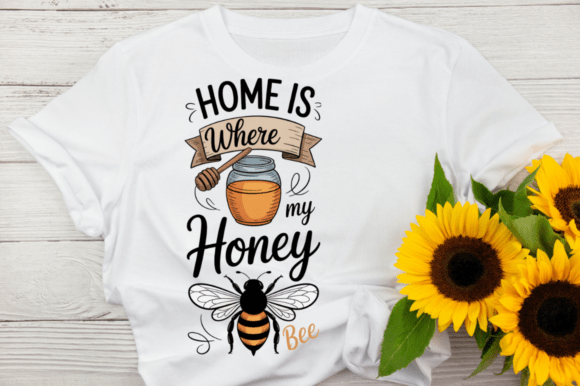
When I first pulled up the Honey Bee PNG Design on my screen, I wasn’t looking for flashy marketing copy. I was looking for clarity, balance, and potential. As an experienced designer who spends half my life digitizing files and the other half stitching them out, I have a specific set of criteria for any graphic I consider for real-world application. This isn’t just about whether an image looks cute on a white background; it is about how that image translates when thread meets fabric. The Honey Bee PNG, often marketed with tags like "Home Is Where Your Honey Bee Shirt Design," presents itself as a versatile asset for crafters and small business owners. But does it hold up under the needle?
First Impressions and Visual Personality
The immediate mood this design creates is warm, inviting, and gently whimsical. It avoids the overly complex shading that often plagues digital illustrations intended for print but fails in embroidery. Instead, the shapes are distinct and bold enough to be recognized from a distance. For those of us working in the realm of Illustrations and Graphics, we know that simplicity is often the key to longevity in stitched products. The layout feels balanced, with a central focus that draws the eye without overwhelming the surrounding negative space. This visual personality makes it a natural fit for projects that aim to evoke comfort, such as nursery decor, kitchen textiles, or cozy apparel.
What stands out most is the potential for interpretation. Because it is provided as a high-resolution PNG with a transparent background, it serves as a robust reference for digitizers. It is not a pre-digitized machine embroidery file with fixed stitch counts, which is actually a benefit for professionals. It allows me to decide whether certain areas should be filled with satin stitch for shine or fill stitch for texture, depending on the fabric I am using.
Real-World Application: From Tote Bags to Sweatshirts
To truly evaluate this design, I imagined a specific scenario: a custom order for a local boutique selling eco-friendly goods. The client wanted a line of canvas tote bags and organic cotton sweatshirts featuring a nature-inspired theme. The Honey Bee PNG Design was my top contender for the centerpiece.
On a canvas tote bag, the design’s bold lines would translate beautifully. Canvas has a coarse weave, so fine details can get lost. However, the structural integrity of this bee illustration suggests it would remain clear even on textured fabrics. I envisioned using a combination of running stitch for the outline to keep the profile crisp, and a moderate density fill stitch for the body of the bee to ensure durability against daily wear. For the sweatshirt, the same design offers a different challenge. Fleece and cotton blends are stretchy and plush. Here, the transparency of the PNG allows me to place the design precisely over the chest pocket area or centered on the back, ensuring it doesn’t distort when the garment is worn.
Beyond apparel, this graphic shines in home goods. Imagine it embroidered on a linen tea towel or a pillow cover. The "home" aspect of the associated text hints at its suitability for domestic settings. In these contexts, the design acts as a subtle accent rather than a loud statement, enhancing the handmade product’s value without dominating the room’s aesthetic.
Navigating Technical Challenges
While the design is strong, practical embroidery requires caution. There are specific scenarios where you must approach this graphic with care. First, consider hoop size. If you are working with a small 4x4 inch hoop, you may need to scale the design down significantly. When reducing size, watch the stitch density. If the original digitizing is too dense, shrinking it can cause puckering, especially on thin fabrics like baby clothes or silk blends. Always test on scrap fabric first.
Dark fabrics present another hurdle. Since this is a PNG and not a vector with inherent color separation, you must plan your thread colors carefully. A yellow bee on a navy blue shirt needs a solid underlay and potentially a border stitch to prevent the dark fabric from showing through the lighter threads. Without proper stabilizer, the contrast might look muddy rather than vibrant. I recommend creating black and white mockups before stitching to check for value contrast. If the design relies solely on color to define its shape, it may lose definition in monochrome or low-light conditions.
Curved surfaces, such as caps or hats, require additional attention. The flat nature of a PNG means you must manually adjust the digitizing to account for the curve of the cap. Dense stitch areas should be avoided on the front panels of caps to prevent stiffness and discomfort for the wearer.
Commercial Viability and Brand Consistency
For Etsy sellers and creative entrepreneurs, the commercial use allowance mentioned in the product description is a significant advantage. It means you can incorporate this Honey Bee PNG Design into finished products for sale, such as personalized gifts, holiday embroidery items, or boutique merchandise. However, professionalism is key. Using a high-resolution, 300 DPI file ensures that your printable mockups and digital product previews look sharp and trustworthy to potential buyers. Blurry images erode customer trust; crisp graphics build it.
This design supports brand consistency if used correctly. If your shop focuses on rustic, natural, or handmade aesthetics, this bee fits seamlessly. It enhances buyer engagement because it feels authentic rather than mass-produced. When customers see a well-executed embroidered patch or applique design derived from a clean source file, they perceive higher quality. This perception directly impacts the perceived value of your handmade product.
Practical Notes for the Embroidery Designer
Before you commit to a full production run, take these steps:
- Check the License: While commercial use is allowed, always confirm the specific terms. Can you sell the digital file itself, or only physical items? Usually, PNGs are for physical end-products or print-on-demand, not for reselling the digital asset.
- Test Stitch Density: If you digitize this yourself, start with a lower density fill. You can always add more passes, but removing stitches is impossible.
- Fabric Compatibility: Test on both woven and knit fabrics. The design may behave differently on a structured apron versus a stretchy t-shirt.
- Thread Choice: Use high-quality rayon or polyester threads to match the vibrancy implied by the PNG. Matte cotton threads might dull the visual impact.
- Stabilizer Selection: Match your stabilizer to your fabric. Cut-away for knits, tear-away for wovens. This prevents distortion and ensures the finished product lasts through washing.
In conclusion, the Honey Bee PNG Design is a versatile and practical asset for the modern maker. It bridges the gap between digital illustration and tactile craftsmanship. By understanding its strengths and respecting its technical limitations, you can create stunning embroidered patches, custom apparel, and cherished personalized gifts that stand out in a crowded market. It is not just a graphic; it is a foundation for quality handmade work.